

Cloud Architect
In today’s cloud-first world, organizations are constantly seeking ways to optimize performance, reduce costs, and meet sustainability goals. AWS Graviton processors are designed to deliver exactly that. They are custom-built by AWS using Arm architecture. At Skaylink, we help our clients harness the full potential of Graviton-based instances, enabling them to modernize their infrastructure and accelerate innovation.
What is AWS Graviton?
AWS Graviton is a family of processors developed by AWS that provide high-performance, energy-efficient computing for a wide range of workloads. Now in its fourth generation, Graviton offers the following:
- Up to 40% better price-performance ratio for a broad array of workloads
- Up to 60% lower energy consumption than comparable EC2 instances
- Support for diverse workloads, including AI/ML, databases, containers, and HPC
Graviton-based instances are available across multiple EC2 families. Each family is optimized for specific use cases, including general purpose and memory/compute optimized workloads.
How is Skaylink leveraging AWS Graviton in practice?
For example, we recently switched a client’s e-commerce stack-commerce stack, consisting primarily of web servers running PHP, from the latest Intel-based EC2 instance family (c7i) to the latest Graviton instance family(c8g).
The key benefits observed with AWS Graviton are:
- Cost savings: ~10% reduction in EC2 on-demand costs
- Performance gains: ~10% faster response times for compute-heavy requests
- Enhanced resource utilization: Instances can handle CPU peaks more effectively due to the increased number of physical cores.
Our approach includes architecture assessments, migration planning, and performance monitoring to ensure optimal results.
What makes AWS Graviton so efficient?
In 2018, AWS released its first-generation Graviton processors, which were designed by its subsidiary, Annapurna Labs. Annapurna Labs is also the creator of AWS Nitro chips and hypervisor, which is the virtualization stack for nearly all modern EC2 instances. Based on the know-how and experiences gained over the last seven years, AWS has continuously improved its Graviton processors, bringing them to the fourth generation.
Unlike traditional x86-based Intel and AMD chips, Graviton chips are powered by Arm’s Aarch64/Arm64 architecture. In recent years, Arm has stepped up its server processor game with the release of Neoverse. The architecture is used not only in every generation of Graviton, but also in Google’s Axion and Microsoft’s Cobalt server processors. With each iteration, Arm processors have been designed and improved to offer high performance while consuming less power and producing less heat.
Another significant difference between most x86-based and Graviton EC2 instance families is their number of physical cores. For example, a c5.large instance has two vCPUs attached to one physical Intel CPU core, while a c6g.large instance has two vCPUs attached to two physical Graviton cores. This has an effect on the performance. A shared CPU core may become a bottleneck, especially when the instance’s CPU usage exceeds 50%.
However, an exception is the latest AMD EC2 instance family, including c7a, m7a, and r7a. These instances provide additional cores and have shown improved performance, but they also come at a higher cost compared to the previous generation.
To sum it up, Graviton offers a better price-to-performance ratio because:
- It uses a more power-efficient architecture.
- It offers more physical cores for EC2 instances.
- The chips are designed in-house for the AWS Cloud environment.
- It is competitively priced compared to x86 variants.
Benchmarks
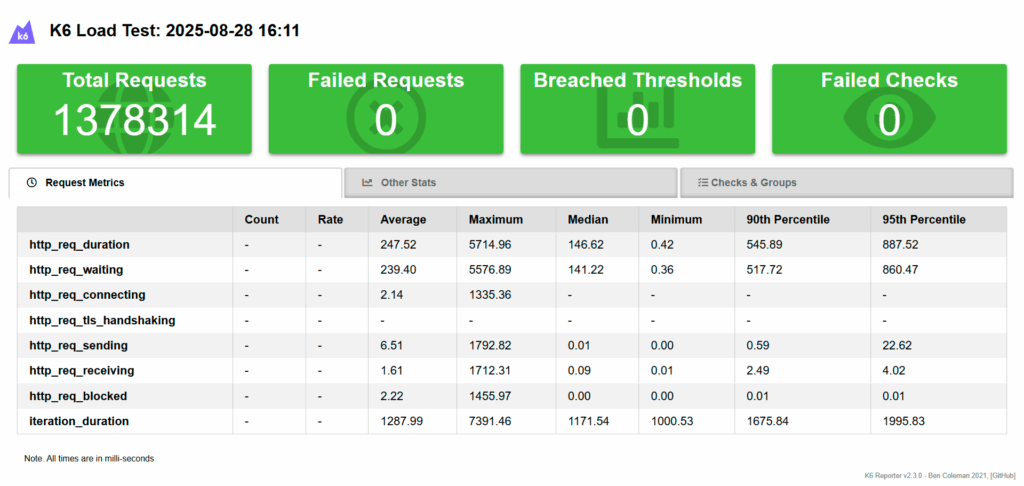
We also conducted a small benchmark test comparing two common instance types for Graviton (t4g.medium, c8g.large) and Intel (t3.medium, c7i.large).
IMPORTANT
- Disclaimer: These benchmarks are for reference only and do not represent real world examples.
- Benchmarks always depict specific synthetic workloads that may favor certain hardware and software configurations.
- Results may be affected by caveats, such as a lack of optimization, bottlenecks, or uncertain long-term performance stability.
Here are the results:
| Instance Type | Frankenphp 8.3 Symfony demo app, K6 Load test (3000 VU’s, 10 minutes, HTTP/2 and HTTPs) requests/sec (higher is better) |
|---|---|
| c7i.large | 163.65 |
| c8g.large | 245.05 |
| t4g.medium | 132.51 |
| t3.medium | 114.54 |
| Instance Type | 7zip benchmark average compression/decompression speed (higher is better) |
|---|---|
| c7i.large | 9332 KiB/s 64689 KiB/s |
| c8g.large | 14117 KiB/s 119249 KiB/s |
| t4g.medium | 8282 KiB/s 86470 KiB/s |
| t3.medium | 6034 KiB/s 51194 KiB/s |
| Instance Type | Spring sample app with postgres K6 Load test requests/sec (3000 Virtual Users, 10 minutes duration, HTTP) (higher is better): |
|---|---|
| c7i.large | 2293.12 |
| c8g.large | 2568.85 |
| t4g.medium | 1294.63 |
| t3.medium | 1381.71 |
Graviton outperformed in all benchmarks except for the Java test comparing t3.medium and t4g.medium. This may be due to the Java 11 runtime. Using Java 17 or 21 could yield different results. Even though t4g.medium is more than ~20% cheaper than t3.medium on-demand, Graviton still provides better value.
Useful tools and guides
AWS offers a range of tools for testing and optimizing Graviton. Here is a short list:
- Porting Advisor for Graviton: https://github.com/aws/porting-advisor-for-graviton
Check your source code for any Graviton optimizations, such as libraries that are not Graviton-optimized.
- AWS Graviton getting started: https://github.com/aws/aws-graviton-getting-started
Guides for developers
- AWS Graviton savings dashboard: https://aws.amazon.com/ec2/graviton/graviton-savings-dashboard/
See how much you can save with AWS Graviton.
Get in touch
Would you like to find out how AWS Graviton can transform your cloud infrastructure? Skaylink’s experts are here to help you evaluate, plan, and implement your migration securely and with scalability in mind.
Let’s talk. We’d love to hear from you. Contact us today to start your Graviton journey.